What does it take for a student to truly focus on a campus that rarely slows down? At the University of Illinois Chicago’s east campus, where space is limited and noise is abundant a new addition to the scene is beginning to reshape that question: Study pods—small, enclosed spaces designed for quiet and concentration. But as students begin to use them, another question emerges: do these pods offer relief, or quietly redefine how students connect with the spaces—and each other—around them?
It’s 10:47 a.m. After bombing your 8 a.m. lab quiz and sitting through the monotoned ramblings of a lecture discussing something about acetylcholine, mitochondria, and yet another looming exam, all you want is a place to sit and regroup—both your schedule and, inevitably, your life choices. So, you head to the commuter center—a space meant to offer exactly that. But alas, every seat is occupied, or worse, claimed, within minutes. Backpacks, laptops, jackets, headphones, iPads, and either overly filled or half-finished Dunkin’ coffee cups mark territory—even when no one is sitting there.
The scene described vividly by Brittney J., a Junior Pre-Nursing student, is all too familiar. She is not the first student to voice their frustrations about lack of seating around campus—and far from the last.
English department’s Clinical Assistant Professor and Director of the Professional Writing Program, Karen Leick, shared an encounter of her own. While on the way to teach a class, she and several students discovered a female student studying alone in a locked classroom.
“She had her headphones or earbuds in, and she must not have heard us, and the door would not unlock from outside, so I ended up getting IT to come down and open it,” Leick recalled.
When the door finally opened, the student was startled, the moment was awkward, but all was forgiving—because none of it was surprising for Leick.
“I don’t think she meant for the door to lock. I think she just wanted somewhere quiet to study,” Leick said. “Really, I don’t blame her. Public areas around UIC, like cafes or lounges, tend to fill up fast, and in multiple buildings. I’ve had many occasions where I was unable to find a good place to either grade assignments or unwind before the next class aside from my office.”
These incidents occurred more than 25 times, some more recent than others.
For Leick, these moments point to a broader issue—not just for students, but across campus.
Throughout UIC’s Liberal Arts & Sciences campus, finding a place to sit has become more than a minor inconvenience—it’s a daily obstacle affecting how students study, rest, and move between classes. With a large commuter population and limited shared spaces, commuters and residents alike often find themselves competing in high-traffic areas—from the library study lounges and study halls to the east campus commuter center, computer labs, and even empty classrooms. Some linger by walls, others make a home on the floor, and many quietly circle rooms or stand around waiting for a seat that may never open.
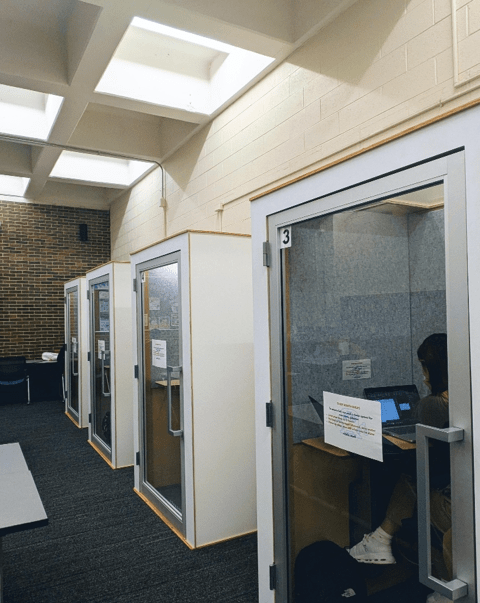
In response to these ongoing challenges, the commuter center has begun introducing privacy pods—compact, enclosed units intended to provide students with a quiet, focused environment. These pods have become a kind of focus sanctuary for students navigating crowded spaces, offering a unique yet effective method of utilizing space at the Student Center East Commuter Resource Center and the Richard J. Daley library.
At the Daley Library, Library specialist Gina Meier, explained that there are currently three study pods, or booths—as they called them—in operation on the second floor at the far south end of the building. The commuter center’s multipurpose room (MPR) contains six pods total alongside shared seating and tables.
The next set of pods are located at the commuter space of the SCE building Wellness Center. This time a set of six pods located inside the Multipurpose Room (MPR). The seating of this area consists of 4-top tables that can seat up to 30 guests.
While the commuter center is designed with commuter students in mind, it has naturally become a shared environment for a broader range of students across campus.
For commuter assistant, Mira F.—her preferred name in the interview—who has worked at the front desk, for over half a year—that overlap is something she sees daily. “We are dedicated to creating a space that students can take pride in—somewhere they feel comfortable and feel like they belong,” she said.
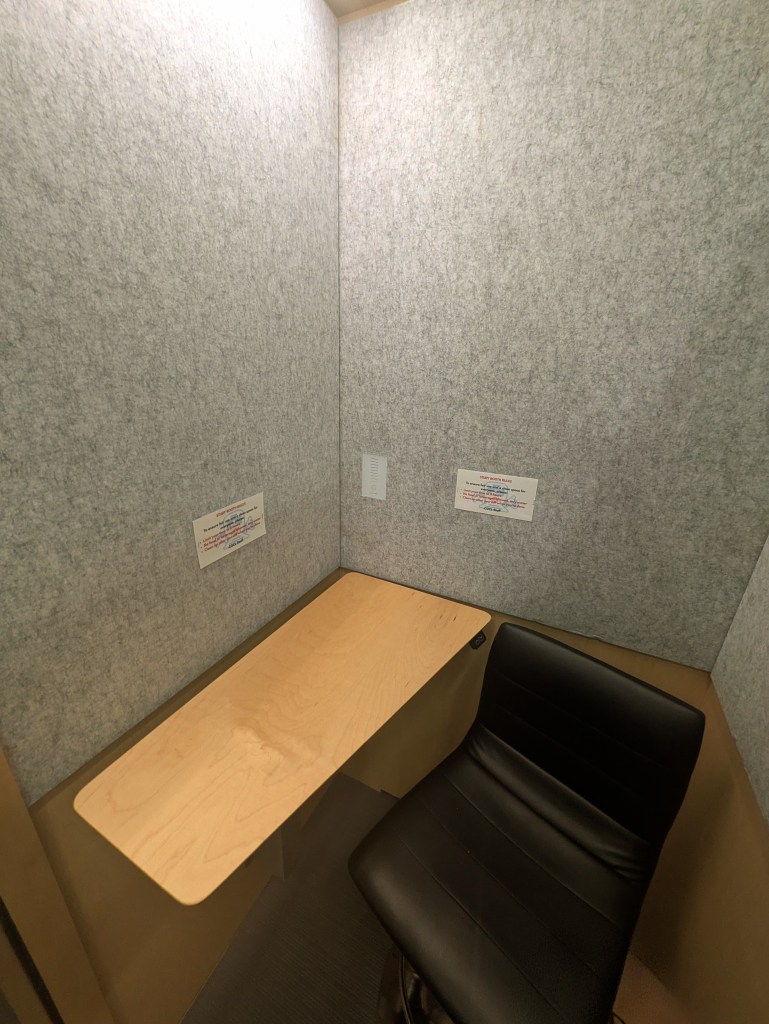
In each pod, there is one revolving chair, a wooden mounted desk that is wide enough for devices, notebooks, and stationery. The inside comes with a light dimmer and soundproof paneling. Placed on the walls are a set of rules prohibiting eating, drinking or being in the pods for more than 2 hours.
As student bodies rushed past, Mira described how students move through the center in waves throughout the day. “Students come here during their break times, and then they leave again to either go to class or go home,” she explained. “So, it becomes a cycle that just works.”
In practice, students are already using the pods in ways that reflect both their intended purpose and the realities of campus life. For Crystal Mo., a sophomore majoring in neuroscience, that experience is still evolving.
While she uses public seating about four times a week she turns to the pods less often— “once or twice every two weeks,” she said, largely because of the “peak hours” that affect her chances.
As a result, access is inconsistent. “They’re all occupied,” Crystal states, making them difficult to rely on when demand is highest. Mira sees a similar pattern, particularly during midday rushes.
“Our busiest hours start around 12 and go through 2 p.m.,” Mira said. “It slows down more way after lunch time and near closing, so 3-5 p.m.”
Even so, according to staff and students, the difference in concentration is immediate once inside.
“I definitely think so,” Crystal said when asked whether her focused improves in the pods. “Usually outside the pods it gets very busy and loud, so I think having the pods could be helpful to block out that noise.”
She also described the pods as most effective when used with intention. “It’s best to have a plan of action when you first enter the box,” she explained. They’re very good when you want to concentrate on a specific task, like private calls.”
That experience aligns with what Mira observes during her shifts. “If you want to take a quick meeting or find a study spot those pods usually first come, first serve, but are worth it to block out any noisiness from other students or whatever may be distracting.”
That pattern is echoed by students Brittany J. and Kevin M., a sophomore in civil engineering, who says he “typically uses the pods towards the end of the day once they get empty,” avoiding peak hours altogether.
“I’d say especially between like 9 a.m. and 3 p.m. is when they are pretty full,” he said.
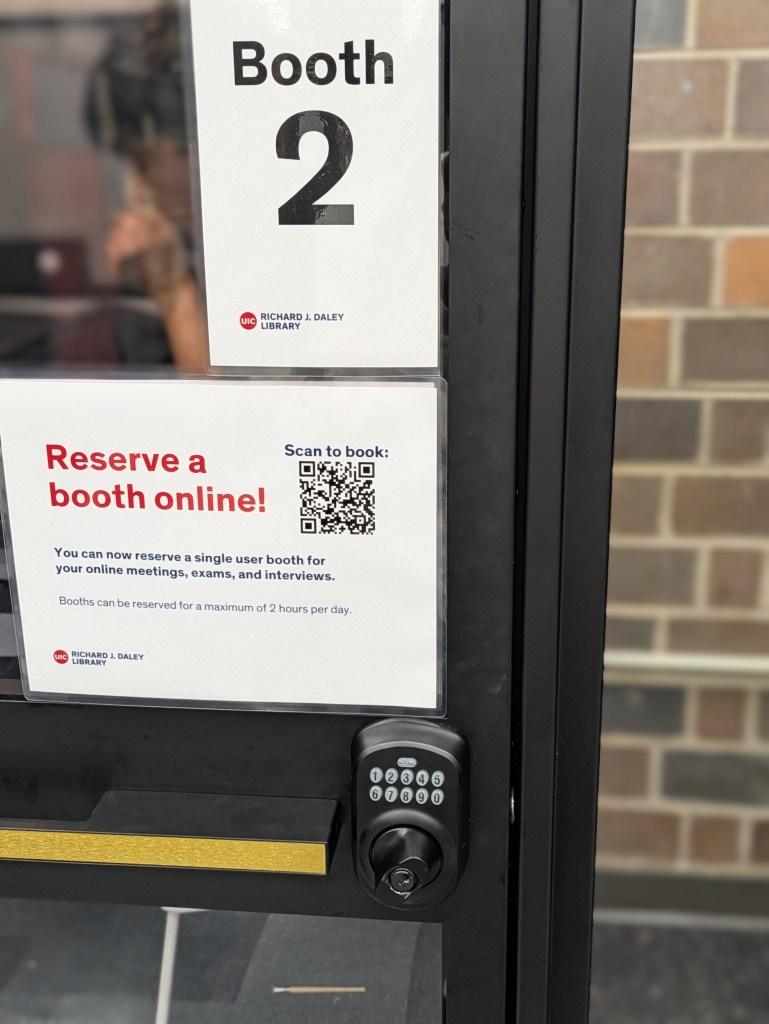
At the Daley library, however, access is handled differently. According to Meier and Senior Library specialist Dante Williams, the pods are reserved through the library’s reservation site.
Meier emphasized the convenience the booths provide for important phone calls, zoom meetings, and even therapy sessions. Unlike the commuter center, the Daley library also includes an accessible study booth.
As for any complaints by the students, Williams had this to say: “They can get cramped for some people but overall the kids love ‘em, seriously”, Williams said.
He and Gina explained that while the pods initially sat mostly unused, they gradually became more consistently reserved over the academic year.
“We could use more individual spaces,” Williams commented. “There’s definitely a lack of those spaces throughout campus for individual privacy.”
“We still get people who are interested in using them, but we just don’t have enough to accommodate everyone,” Meier added.
What neither initially mentioned, however, was how difficult it can be to actually reach the library’s pods.
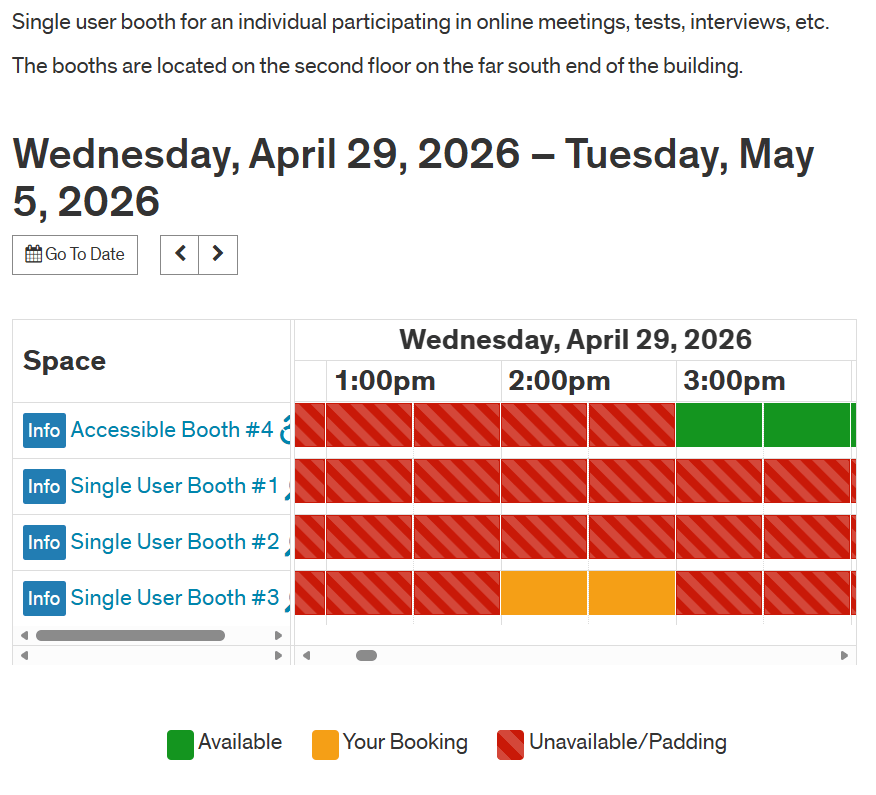
The directions themselves seem simple enough, but the pods are located far from the library’s main flow of traffic. For students, especially those unfamiliar with the layout—this can become discouraging.
As Wilder, a graduating senior English major and frequent pod user, explained while providing escort, “It can be really difficult for a lot of students. By the time you get closer to the pods you lose interest and just find the usual table seating or one of these cubicles which are much closer.”
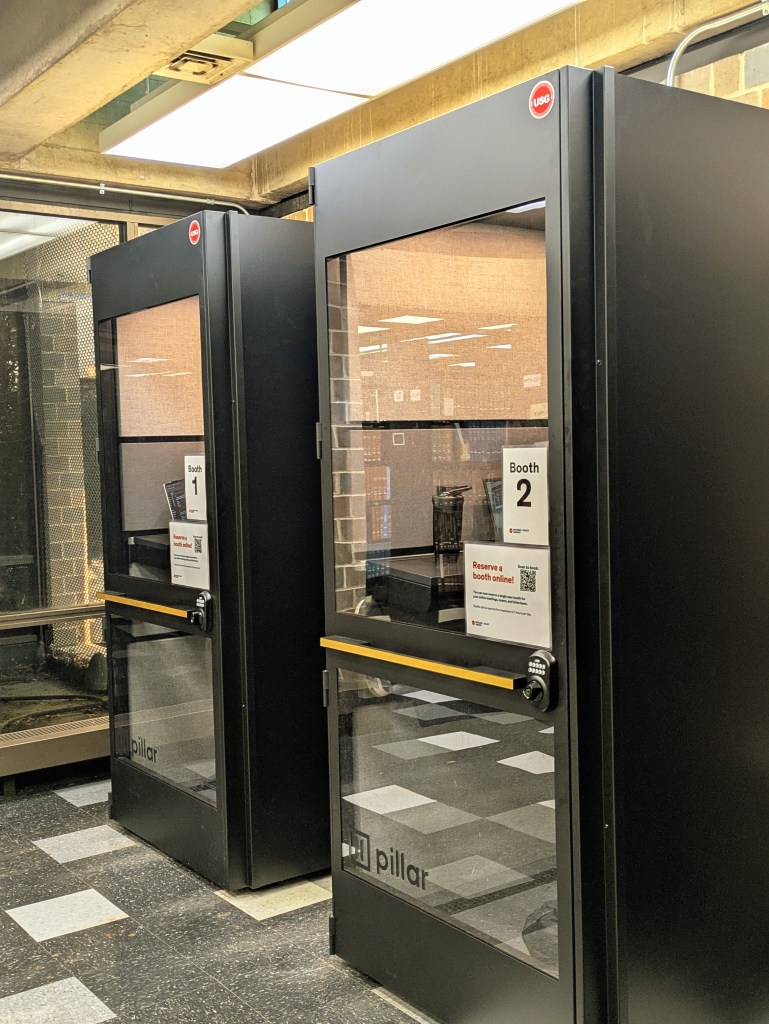
Despite this, the pods are still being filled to the brim by reservations.
Both Williams and Gina also pointed to maintenance concerns. One involved a broken seat that is yet to be seen to which Gina deemed as disappointing but expected, “It’s the difference between a chair you have at home versus a chair that has 16 different people sitting in it, 16 hours a day”.
The second one is found in both areas’ pods, which is issues with ventilation.
According to Meier, the library booths use a fan system that activates once the door closes. “I’ve heard the opposite complaint from more than one person that once the ventilation kicks on, it actually gets really cold, really fast,” She explained.
At the commuter center, students reported the opposite issue.
“At times, they can get really warm,” Kevin said, particularly during winter heating periods or unusually warm days.
Crystal shared that she often takes breaks between study sessions to minimize the heat buildup, while Brittney recalled her own experience with the pods being cut short because of the warmth.
Even with those limitations, the pods offer something different that students value in the spaces.
“I think it’s a good idea regardless of the cons because it provides another space for students to focus,” Crystal said. “It brings students a change in environment.”
Rather than isolating students, many describe the pods as a space to reset, refocus, and return.
For Kevin, that benefit becomes practical.
“the pods bring me peace of mind”, he said describing how he used one during an interview to ensure silence and remain fully present. “Before the interview, I could even talk out loud to get a feel for the flow of the call,” he added—something that would be difficult in a shared space.
For others, like Crystal Mo. and Brittney J., the benefit lies in flexibility.
“It might put me in a better head space,” Crystal said. “You can switch between socializing in a bigger environment and concentrating on your own work, so the loud noises don’t affect me as much.”
While research on student use remains limited, studies in workplace environments have found that similar enclosed spaces can improve satisfaction with privacy and the ability to find appropriate places to work—suggesting these effects may extend beyond the workplace.
For now, the pods signal how space is negotiated on campus—less about finding a seat and more about creating one. The pods offer a glimpse into what student space could become—structured, intentional, individualized, and adaptable—but whether that vision extends beyond a single room is still taking shape.


Leave a Reply