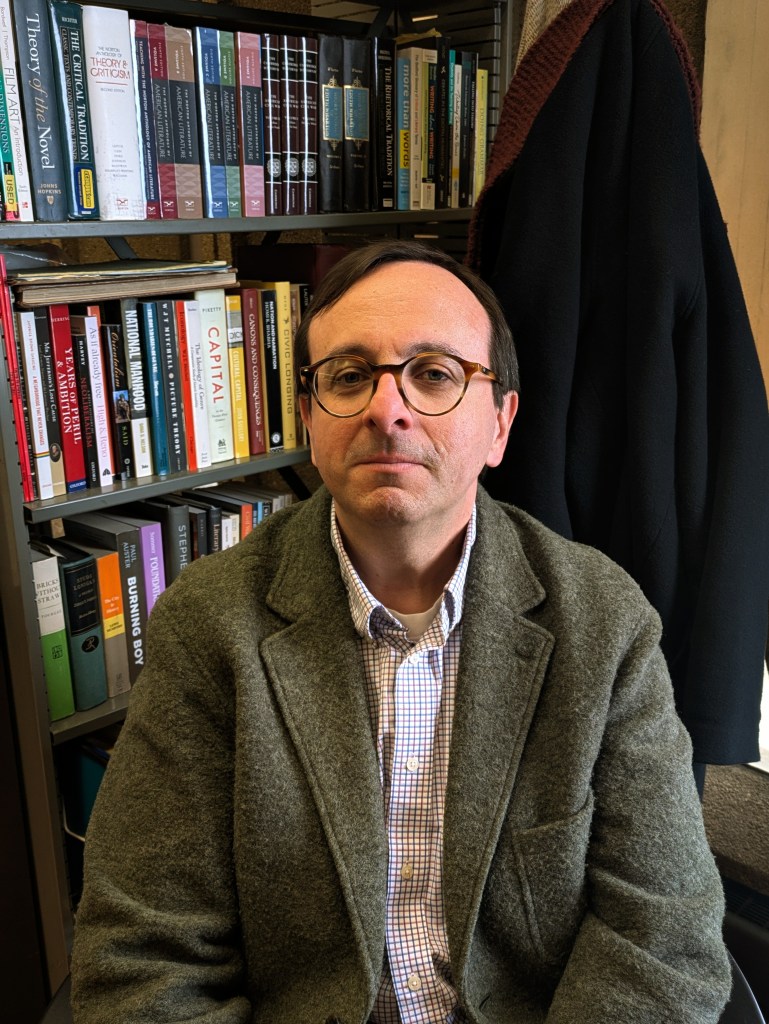
As artificial intelligence becomes increasingly integrated into writing classrooms, Professor John Anthony Casey is not primarily focused on its speed or convenience. Rather than being fully pro-AI or anti-AI, he approaches the technology with measured hesitation, questioning what may be lost in the writing process when efficiency becomes the priority. For him, writing has always been tied to expression—to the shaping of thought itself.
“I’m trying to figure out where it’s not useful,” Casey explains of AI. While he acknowledges that artificial intelligence can assist with routine communication tasks, his larger concern is its impact on cognition. “There’s something about the process of thinking that’s connected with writing that’s really different.” For Casey, writing is not simply a product to be generated. It is a process through which ideas are shaped, refined, and connected to lived experience. The fear is not technological advancement itself, but what may be quietly displaced—especially when young students begin relying on tools before developing confidence in their own intellectual capacities.
He describes society as participating in what feels like a “mass experiment.” The long-term consequences remain. Beyond intellectual implications, he also raises environmental concerns: electricity consumption, water usage for cooling data centers, and the hidden costs of digital infrastructure. “You have to ask yourself, is it worth it?” he says.
When asked whether AI could someday function as a teacher, Casey does not dismiss the possibility. “AI agents already function like tutors or teaching assistants,” he notes. Basic instructional tasks are possible. But essential personable elements of teaching—spontaneity, unpredictability, relational presence—remains something else entirely. Automation may simulate structure, but connection cannot be programmed. “I’m confident that some form of writing will persist,” he says, “because people hunger for connections to each other.”
That emphasis on connection is not abstract. It informs both his research and his teaching.
As a Senior Lecturer in English at the University of Illinois-Chicago, Casey’s work is writing intensive in multiple ways. He teaches writing courses, reads and responds to extensive student work, and produces prose that extends beyond the classroom. He currently has three research projects underway: an article on the American novelist Willa Cather, a study of the television series Reservation Dogs presented at the Midwest Modern Language Association conference, and a developing project on artificial intelligence and composition.
While the subjects vary, they are unified by an interest in how language functions—how people make meaning through words across time and medium. He is also the author of New Men: Reconstructing the Image of the Veteran in Late Nineteenth-Century American Literature and Culture, a book that reflects his sustained interest in literary representation and cultural identity.
Yet Casey’s professional identity did not begin with research. It began with encouragement.
During his collegiate journey, Casey completed his undergraduate studies at the University of Vermont before later earning his PhD at the University of Illinois-Chicago. As an undergraduate, he declared his English major early. Though he later added Latin at the insistence of a high school teacher who believed he could follow in her footsteps, his attachment to English stemmed from something different.
“What drew me to English was more for the creative expression and freedom,” he explains, emphasizing that language was not simply about grammar or vocabulary, but about possibility. Elementary teachers encouraged him to write short stories to always connect with his imagination and developing voice; his grandmother, whole he recalls as a steady cheerleader in his life, reinforced that motivation.
Confidence, however, was not something he possessed effortlessly. Casey describes himself as a perfectionist who was, and somewhat still is, “very sensitive to criticism” and prone to sitting with a piece of writing longer than necessary to ensure it is “just right.” According to Casey, working under a dissertation advisor who shared similar traits intensified these tendences. Yet over time, that self-awareness evolved into something productive.
Rather than hardening into rigidity, it deepened his empathy. “Being aware of your own character traits makes you feel more connected to other people,” he reflects, “it fosters patience and forgiveness because you have been the one stuck in the middle table, who was capable of doing well but not yet ready, and not yet ready to believe you were smart enough.”
This nuanced patience and empathy defines his teaching. “People can be smart without fitting into a conventional framework,” Casey elaborates. Rather than focusing exclusively on top performers, he pays close attention to students who are trying but struggling—those who may not initially excel in traditional assessment structures. He explains that he breaks complex ideas into smaller components so students can recognize their own capability and avoid exclusion.
When asked what student work has been most impactful, Casey does not cite awards or publications. Instead, he says, “It has been the projects where students connect coursework to their larger interests.” He recalls one student who transformed a class paper on mobile health clinics into a research assistantship, later earning a master’s degree at the Harvard School of Public Health and an MD. Another student who wrote about water quality and microplastics went on to work in chemistry labs and public health research.
Casey is careful to clarify that he does not claim ownership over their success. “I didn’t do any of that—that was all them,” he says, describing himself as “kind of humbled but so honored to be a part of their journeys.” For him, assignments are not endpoints, they are entryways.
In many ways, Casey’s concerns about artificial intelligence return to the same place his teaching does: confidence and connection. If writing becomes something outsourced too early, the growth of confidence becomes fragile. If learning becomes transactional, connection becomes secondary. Professor John Casey has claimed to be in a “gray area” about whether artificial intelligence would be beneficial or a detriment to cognitive development. However, his stated hesitation toward AI is not resistance to innovation, but a defense of what cannot be replicated—the gradual shaping of thought, the strengthening of one’s own intellectual voice, and the relationships that make that growth possible.
For Professor Casey, writing remains inseparable from thinking and the art of human expression, and teaching remains inseparable from essential social development. Technology may continue to evolve, and classrooms may continue to adapt. But confidence cannot be downloaded, and connection cannot be programmed. Those are cultivated through attentiveness, consistency, and the willingness to work through ideas rather than bypass the process.
In an era increasingly defined by efficiency, Professor John Casey’s work suggests something steadier: that education, at its core, is about helping students learn to trust their own minds—and to do so within communities where human connection still matters.
 HOME
HOME 
Leave a comment